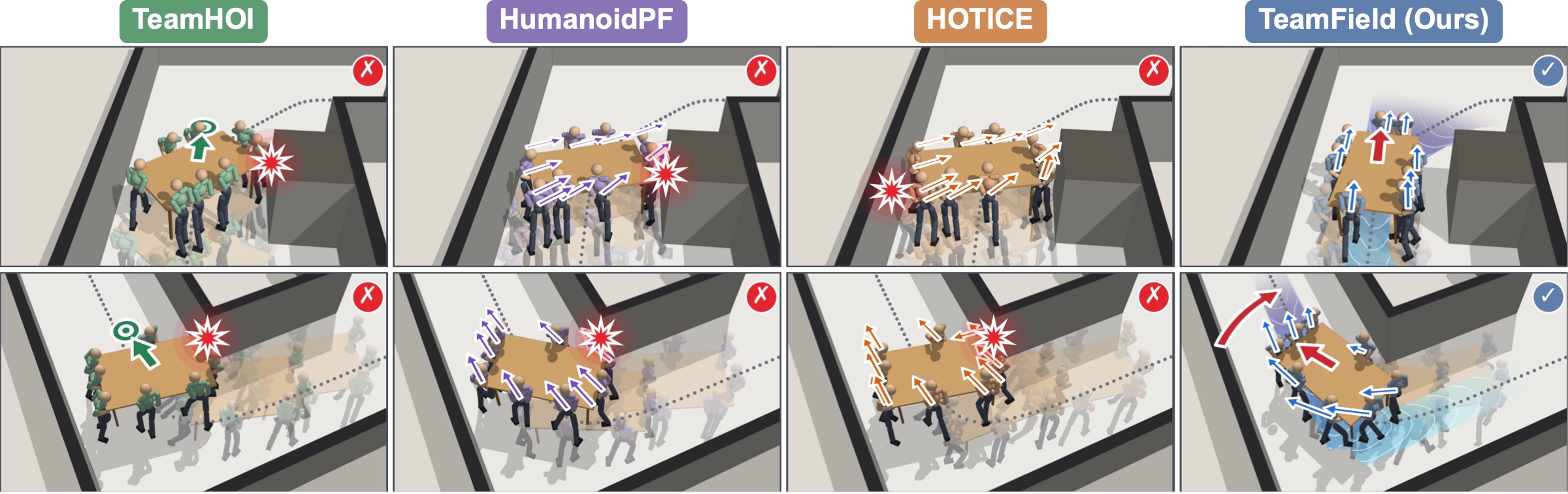
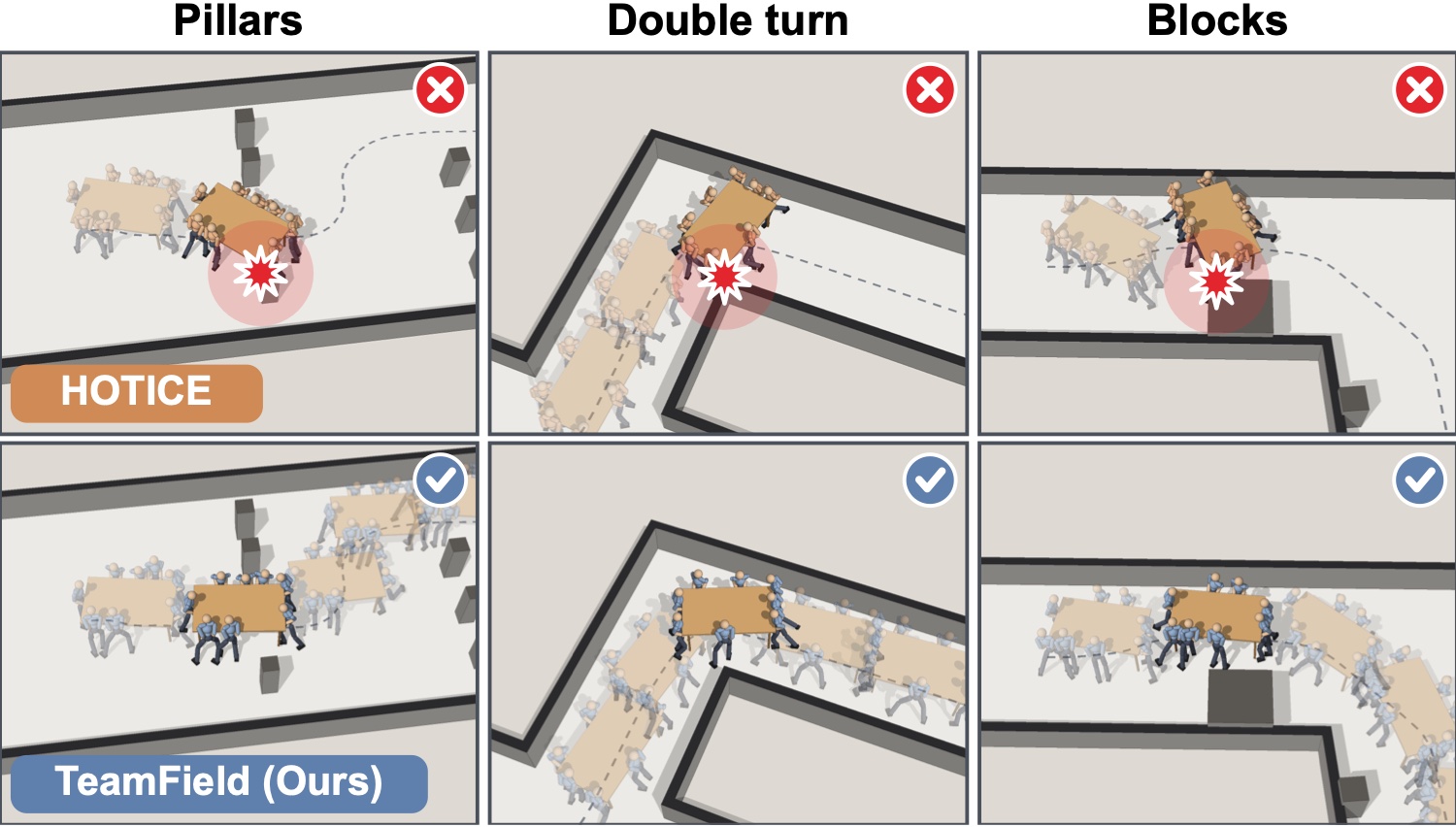
TeamField is the first reinforcement learning framework for humanoid collaboration in challenging environments.
We show TeamField with prior methods in scenarios that require precise team motion.
By defining a novel team field and training a policy to follow it, TeamField coordinates movement and rotation across the entire team to avoid collisions.
Abstract
As a human needs collaboration to complete challenging tasks, a humanoid also needs collaboration to expand its individual capabilities.
Despite its importance, such collaboration remains underexplored in challenging environments.
Existing methods focus on cooperation in open spaces or obstacle avoidance by a single humanoid.
We present TeamField, a reinforcement learning framework that orchestrates the motion of an entire humanoid team in challenging environments.
TeamField models the object and all humanoids as a single rigid body and introduces a novel field that jointly guides the team's translation and rotation toward the goal through collision-free space.
TeamField converts this motion into distinct commands for individual humanoids.
Through two-stage training, the policy first learns to follow diverse team commands in open space, then learns to execute TeamField's commands in cluttered environments.
To evaluate humanoid collaboration, we also introduce CarryBench, a benchmark for cooperative carrying through narrow passages, sharp corners, and cluttered environments.
TeamField outperforms existing methods on unseen layouts and course types, particularly in confined spaces that require precise team motion.
Videos
Each video shows TeamHOI, HumanoidPF, HOTICE, and TeamField on the same test episode.
A baseline's panel stops at its first contact. TeamField's panel shows Success when the team reaches the goal.
In all 22 videos, the three baselines make contact and TeamField reaches the goal without contact.
TeamHOIHumanoidPFHOTICETeamField (Ours)Contact first contactSuccess goal reached
0.0 s
Drag the time bar to move all four teams back and forth. The marks show each baseline's first contact and TeamField's arrival.
Sharp turnIn-domain test layoutOne corner with a turn angle between 95° and 155°.
Method
TeamField defines a field that guides the team's movement and rotation based on the space occupied by the object and all humanoids.
It turns this guidance into a velocity command for each humanoid, which the policy learns to follow.
Why guide the whole team?
Safe space for the entire team.
Even when the object fits through a narrow passage, the humanoids carrying it still risk hitting the walls,
and whether the team fits depends on how it is oriented.
Guidance at individual body points is not enough to assess safe passage for the entire team.
From team motion to individual motions.
At a sharp corner, the outer humanoids need to travel farther than the inner ones,
so each humanoid needs a different motion command based on its position.
A waypoint tells the team where to go, but not which direction the entire team should face in a narrow passage or how to turn at a corner.
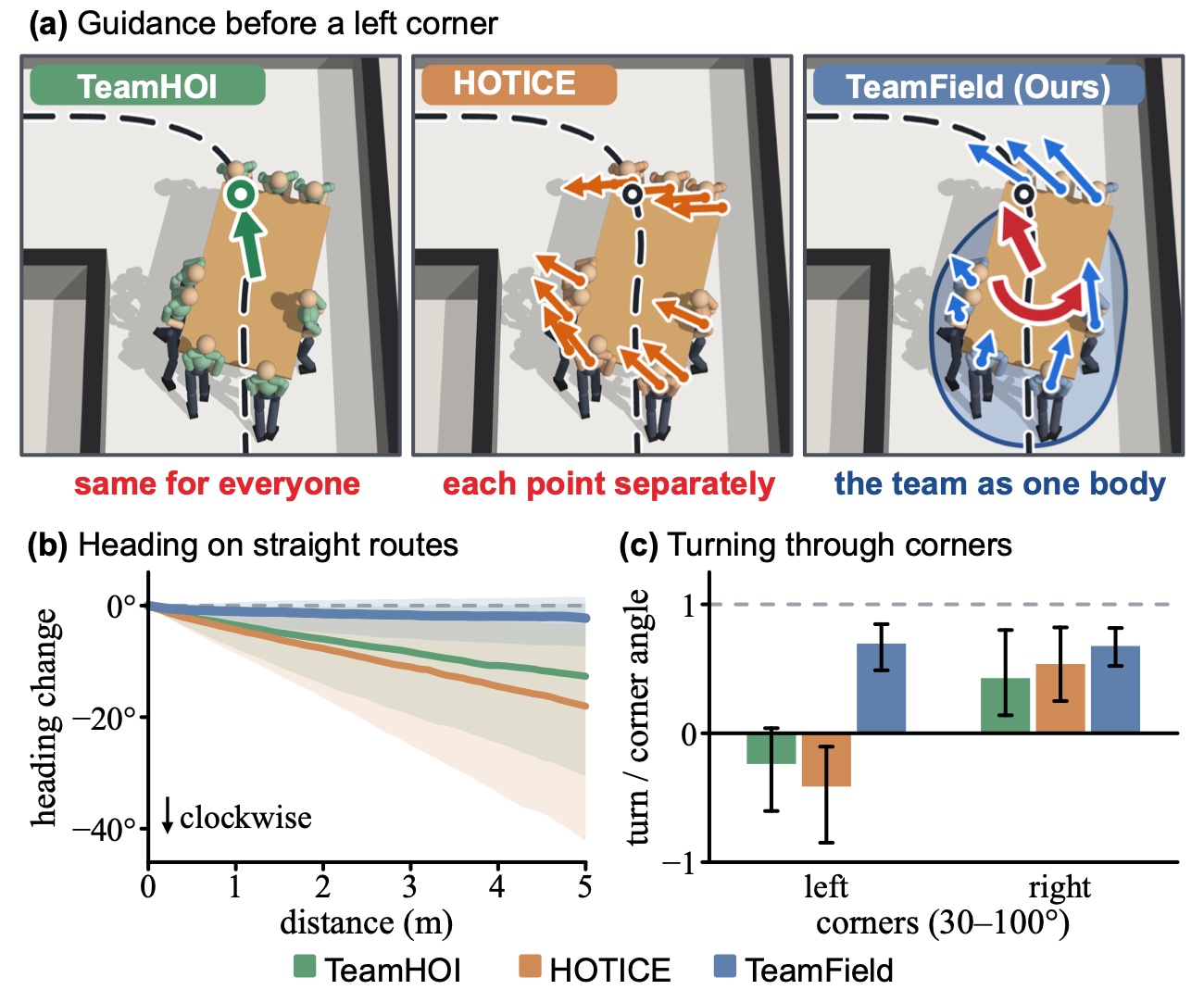
Existing methods exhibit large changes in object heading on straight paths,
and the change in object heading does not closely match the corner angle.
Effect of guidance on the table's heading.
Fine-tuned with a waypoint (TeamHOI) or point fields (HOTICE), teams let the table drift clockwise (b) and turn the wrong way at left corners (c).
Medians and middle halves, in-domain test set.
Overview
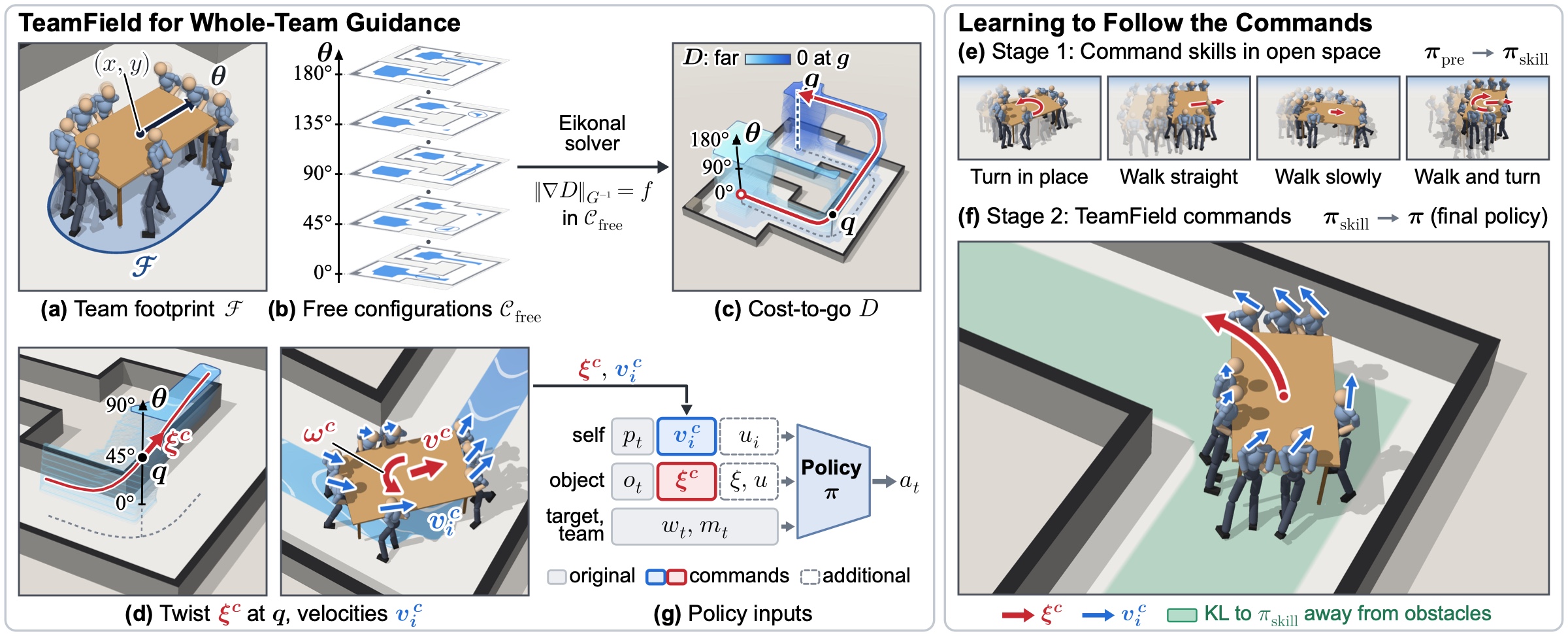
Overview of TeamField.
Once per environment, TeamField finds the free configurations \((x, y, \theta)\) of the measured team footprint \(\mathcal{F}\) (a, b) and their cost-to-go \(D\) (c).
At every control step, its steepest descent at the team's configuration is a twist of the object, shared among the humanoids as velocity commands (d).
The policy learns to follow them in two stages (e, f) with new inputs (g).
once per map
1
Team configuration space
The object and all humanoids carrying it are modeled as one rigid body with configuration \(q = (x, y, \theta)\).
Its shape is the team footprint \(\mathcal{F}\), estimated from the areas the humanoids' bodies occupy while the pretrained policy carries the object.
At each of \(N_\theta = 72\) headings, FFT-based correlation of the rotated footprint with the obstacle map gives the free configurations \(\mathcal{C}_{\mathrm{free}}\).
A passage that fits the object at any heading admits the whole team at only a few headings.
once per map
2
Team cost-to-go
Path length counts translation and rotation together, with \(\rho\) the team's radius of gyration:
$$ds^2 = dx^2 + dy^2 + \rho^2\, d\theta^2.$$
A clearance cost \(f(q)\) keeps paths away from obstacles where there is room and lets them pass through narrow feasible gaps.
The cost-to-go \(D\) solves the eikonal equation
scaled to a nominal speed and a maximum turning rate to give \(\xi^c = (v^c, \omega^c)\).
Humanoid \(i\), at offset \(r_i\) from the object center, receives
$$v_i^c = v^c + \omega^c J r_i,$$
so humanoids on the outside of a turn walk faster than those on the inside.
Learning to follow the commands
The pretrained TeamHOI policy receives a waypoint but no command for how fast the team should move or turn.
We add the humanoid's velocity command \(v_i^c\), the team twist \(\xi^c\), the current object twist \(\xi\), and two obstacle urgencies \(u_i, u\)
to its self and object tokens. Their weights start at zero, so training begins from the pretrained behavior.
With the object already lifted, the team follows sampled team commands: stopping, turning in place, straight walking, slow walking,
and turning while walking in any direction. Rewards track each humanoid's walking velocity and the object's turning rate.
Stage 2
TeamField commands in cluttered environments
The policy is fine-tuned on cluttered training courses with the commands TeamField computes at every control step.
A KL penalty toward the Stage 1 policy, applied only away from obstacles, preserves the learned gait and coordination.
CarryBench
A benchmark for cooperative carrying through narrow passages, sharp corners, and cluttered environments.
Each layout is a single course from a start to a goal.
When traversing a corridor, TeamHOI's teams typically occupy a width of \(W = 2.51\) m.
Every narrow passage is \(W + 2m\) wide, leaving a margin \(m\) on each side, and every layout is certified passable for a rigid footprint of width \(W\).
With test margins from 0.20 to 0.40 m, a corridor is about as wide as the team footprint is long.
8 + 4
in-domain and out-of-domain course types
960
training layouts
1,560
in-domain test layouts, 6,240 episodes
1,722
out-of-domain test layouts, 6,888 episodes
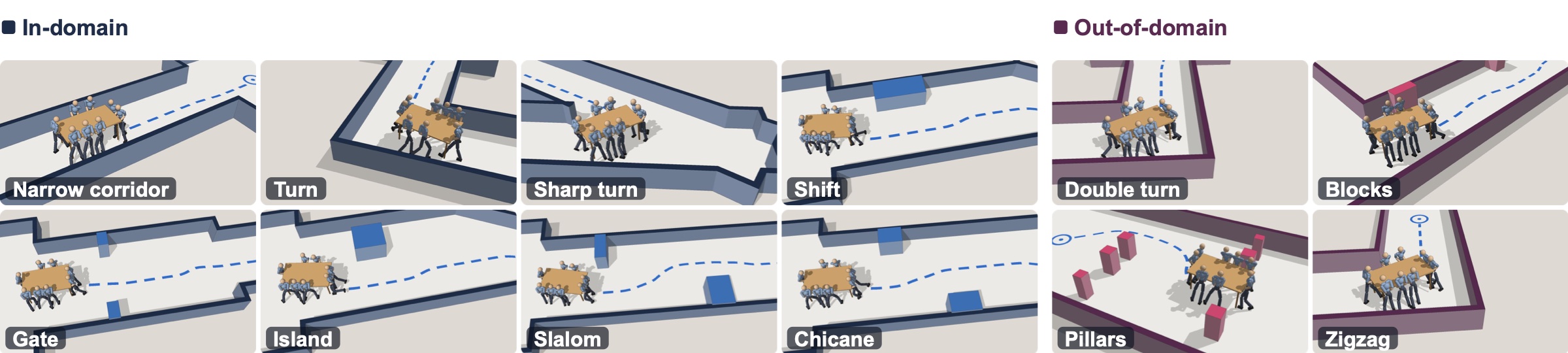
Course families of CarryBench.
One test layout per in-domain course family and OOD course type, with the team placed on its route.
A hallway has a block on one wall (shift), on both (gate), a free-standing one (island), or two on opposite walls, far apart (slalom) or close (chicane).
Indoor scenes.
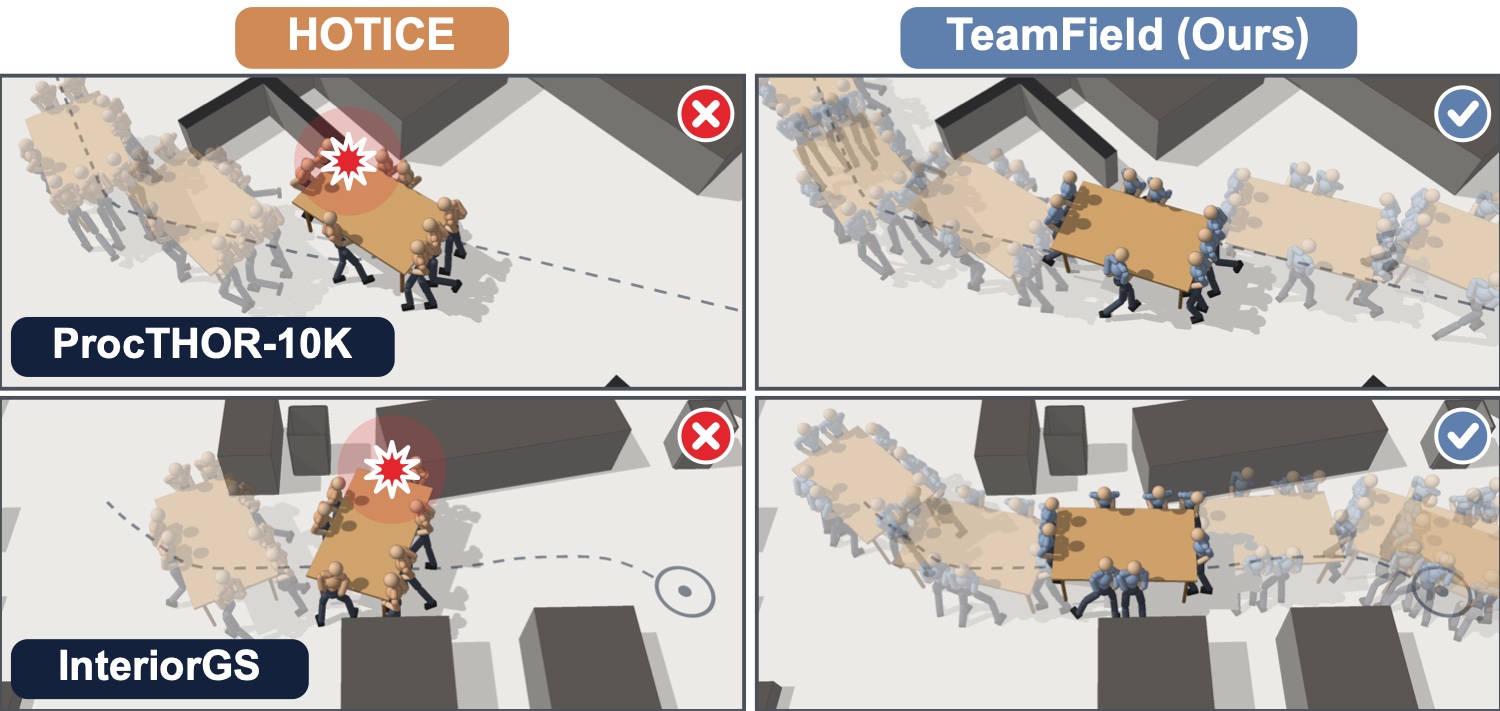
We also evaluate on unseen indoor scenes from ProcTHOR-10K, enlarged by 2.5 and 3 to accommodate the team, and from InteriorGS, at its original size and enlarged by 2.
Start-goal pairs have geodesic distances from 8 to 30 m, and every tested episode is certified team-passable.
Results
SR is the contact-free success rate: the object must reach within 3 cm of the goal in the time limit,
with no contact during navigation or the 5 s after arrival.
Contact occurs when a body or table point stays within 1 cm of an obstacle for two steps.
CarryBench
TeamHOIpre is the released TeamHOI policy. TeamHOI fine-tunes it with waypoint guidance and contact penalties.
HumanoidPF and HOTICE adapt point-field guidance to the carrying team. All fine-tuned methods share the base reward, the KL penalty,
the training courses, 4000 training epochs, and checkpoint selection. TeamField achieves a success rate above 99% on both test sets.
Comparison on the CarryBench test sets.
SR is the contact-free success rate (%), averaged over course families, and \(d\) the distance to the goal (m), at the first contact if any.
Contact and \(t_{\mathrm{coop}}\) are in %, and jerk is in m/s³. Fine-tuned methods report mean ± std over three seeds.
Method
Guidance
In-Domain test
Out-Of-Domain test
In-Domain test
SR ↑
\(d\) ↓
SR ↑
\(d\) ↓
Contact ↓
\(t_{\mathrm{coop}}\) ↑
Jerk ↓
TeamHOIpre
waypoint
75.1
2.64
69.0
2.73
26.6
93.1
41.5
TeamHOI
waypoint
79.6±5.0
2.12±0.64
71.2±4.5
2.62±0.50
24.5±5.1
96.7±0.2
36.1±0.3
HumanoidPF
point fields, per humanoid
85.1±1.3
1.49±0.17
79.2±1.6
1.63±0.02
17.3±1.0
96.2±0.7
32.4±0.6
HOTICE
point fields, per team
87.4±1.1
1.30±0.09
83.5±1.6
1.48±0.13
15.2±1.2
96.5±0.4
31.2±0.6
TeamField (Ours)
team commands
99.5±0.1
0.06±0.01
99.3±0.1
0.07±0.01
0.4±0.0
99.0±0.3
26.0±0.2
Indoor scenes from public datasets
On unseen ProcTHOR-10K and InteriorGS scenes, TeamField improves the success rate by 22.1 to 38.4 percentage points over the best baseline in each setting.
Comparison on indoor scenes from public datasets.
SR (%) on test sets built from ProcTHOR-10K houses enlarged by 2.5 and 3 and from InteriorGS scenes at their original size and enlarged by 2,
all unseen in training, with the number of test layout pairs in parentheses.
Method
ProcTHOR-10K ×2.5 (917)
ProcTHOR-10K ×3 (960)
InteriorGS ×1 (61)
InteriorGS ×2 (220)
TeamHOIpre
52.1
64.6
69.7
64.9
TeamHOI
53.1
66.5
69.3
67.9
HumanoidPF
56.6
73.1
69.5
68.0
HOTICE
56.0
69.0
73.0
71.5
TeamField (Ours)
95.0
97.8
97.3
93.6
Comparison of HOTICE and TeamField on OOD test layouts.
HOTICE (top) turns the table between pillars and blocks and cuts the corner of the double turn, touching them (star).
TeamField (bottom) keeps a heading at which the team fits.
Comparison of HOTICE (left) and TeamField (right) on indoor test scenes.
ProcTHOR-10K (top) and InteriorGS (bottom). HOTICE cuts a corner (top) or turns the table between pieces of furniture (bottom),
making contact with nearby obstacles (marked by stars), as all fine-tuned baselines do in these episodes.
Other tables and team sizes
Larger tables and four- or six-person teams, without retraining. TeamField recomputes the footprint \(\mathcal{F}\) for each geometry.
Planning a feasible table heading before a turn is more effective than independently avoiding obstacles at sampled points.
Generalization to different table sizes and team sizes.
CarryBench ID/OOD SR (%) without retraining. Fine-tuned policies are trained only with eight humanoids and the 2.0×1.2 m table.
Method
Long table (3.0×1.2 m)
Large table (3.0×1.4 m)
Four humanoids
Six humanoids
ID
OOD
ID
OOD
ID
OOD
ID
OOD
TeamHOIpre
3.1
1.9
2.5
1.0
84.7
81.1
80.7
76.1
TeamHOI
3.7
2.4
2.4
1.5
80.3
74.6
77.8
70.6
HumanoidPF
3.0
1.9
3.0
1.8
80.0
74.6
84.6
79.6
HOTICE
8.5
4.7
8.5
3.9
84.2
81.0
88.0
83.7
TeamField (Ours)
94.7
91.3
82.2
75.8
91.2
90.2
98.8
98.5
Ablation
Trained directly in cluttered environments without Stage 1, waypoints and contact penalties alone reach 73.9% ID SR, whereas TeamField's team commands reach 98.0%.
Stage 1 further improves OOD success from 96.5% to 99.4%, and removing the command inputs after Stage 1 reduces performance.
Replacing the measured footprint \(\mathcal{F}\) with the table alone or a single fixed carrying arrangement slightly reduces success.
Ablation of TeamField. Effects of team commands, training stages, and footprint representation.
Team command
Team footprint
Stage 1
Stage 2
ID SR (%)
OOD SR (%)
–
–
–
–
75.1
69.0
–
–
–
✓
73.9
66.2
–
–
✓
✓
62.9
55.5
✓
\(\mathcal{F}\)
✓
–
92.9
89.8
✓
\(\mathcal{F}\)
–
✓
98.0
96.5
✓
table
✓
✓
97.7
98.0
✓
arrangement
✓
✓
98.8
98.2
✓
\(\mathcal{F}\)
✓
✓
99.6
99.4
BibTeX
The entry will be updated when the paper is public.
@article{teamfield2026,
  title   = {TeamField: Reinforcement Learning for Humanoid Teams with Cooperative Motion Fields},
  author  = {Jinwoo Jang and Jaewon Lee and Mangyu Kong and Minsu Jeon and HyungGi Jo and Euntai Kim},
  journal = {arXiv preprint},
  year    = {2026}
}